Teen Patti has been dealt at Indian kitchen tables for generations, usually around Diwali, usually with someone insisting they know exactly what everyone else is holding. The phone version runs the same game every day of the year, for real money, against people you cannot read across a table.
Most guides on how to play Teen Patti stop after the hand rankings. That is the easy part, and it is not where beginners lose money. They lose it on the price difference between playing blind and playing seen, on a sideshow they never use, and on folding hands that were actually ahead. This guide covers all of it, including the real probability of every hand, because knowing that a pair turns up about once every six deals changes how you bet far more than memorising a list.
Chapter 1: The table before a single card is dealt
Teen Patti runs on a standard 52 card deck with no jokers in the classic game. Tables are usually three to six players. Everyone gets three cards face down, and nobody gets more cards after that. Whatever you are dealt is the hand you finish with, which is why the game is decided by betting rather than by drawing.
Four words do most of the work in this game, so get them straight before anything else.
- Boot. The fixed amount every player puts in before the deal. It creates the pot and it sets the opening stake. A table advertised as a 10 rupee table means a 10 rupee boot.
- Pot. The money in the middle. The winner of the hand takes all of it.
- Current stake. The amount a blind player has to match right now. It moves during the hand and it is the number every bet is calculated from.
- Table limit. The ceiling on the pot or on a single bet. When the pot hits it, the hand goes straight to a show instead of continuing.
Chapter 2: Blind or seen, the decision that sets your price
After the deal you choose whether to look at your cards. Play without looking and you are blind. Look and you are seen for the rest of the hand. That single choice changes what every bet costs you.
| You are | Minimum bet | Maximum bet |
|---|---|---|
| Blind | 1x the current stake | 2x the current stake |
| Seen | 2x the current stake | 4x the current stake |
Read that table again, because it is the most useful thing on this page. A blind player is contesting the same pot at half the price. Nothing about the cards changes. Only the cost does.
A hand, priced out
Four players, 10 rupee boot. Everyone pays in, so the pot starts at 40 and the current stake is 10.
- Player A stays blind and bets the minimum, 10. Pot is 50. The stake is still 10.
- Player B stays blind and doubles, 20. Pot is 70. The stake is now 20.
- Player C looks. C is seen, so the cheapest legal bet is twice the stake, 40. Pot is 110.
- Player D looks, does not like it, folds. D loses the 10 already contributed and nothing more.
- Back to A, still blind. A faces a stake of 20 and can continue for 20 while C is paying 40 to stay in the same hand.
That is the whole trap. New players look at their cards immediately because it feels like the responsible thing to do, then pay double for the privilege of folding two bets later. Experienced players stay blind through the cheap early rounds, let the pot build at half cost, and only look when the stake has climbed enough to matter.
There is a second reason to stay blind, and it has nothing to do with money. Nobody can read you. A blind player has no reaction to control, no tell to hide, and no idea whether they are bluffing, which makes them genuinely difficult to play against.
Chapter 3: Hand rankings, strongest to weakest
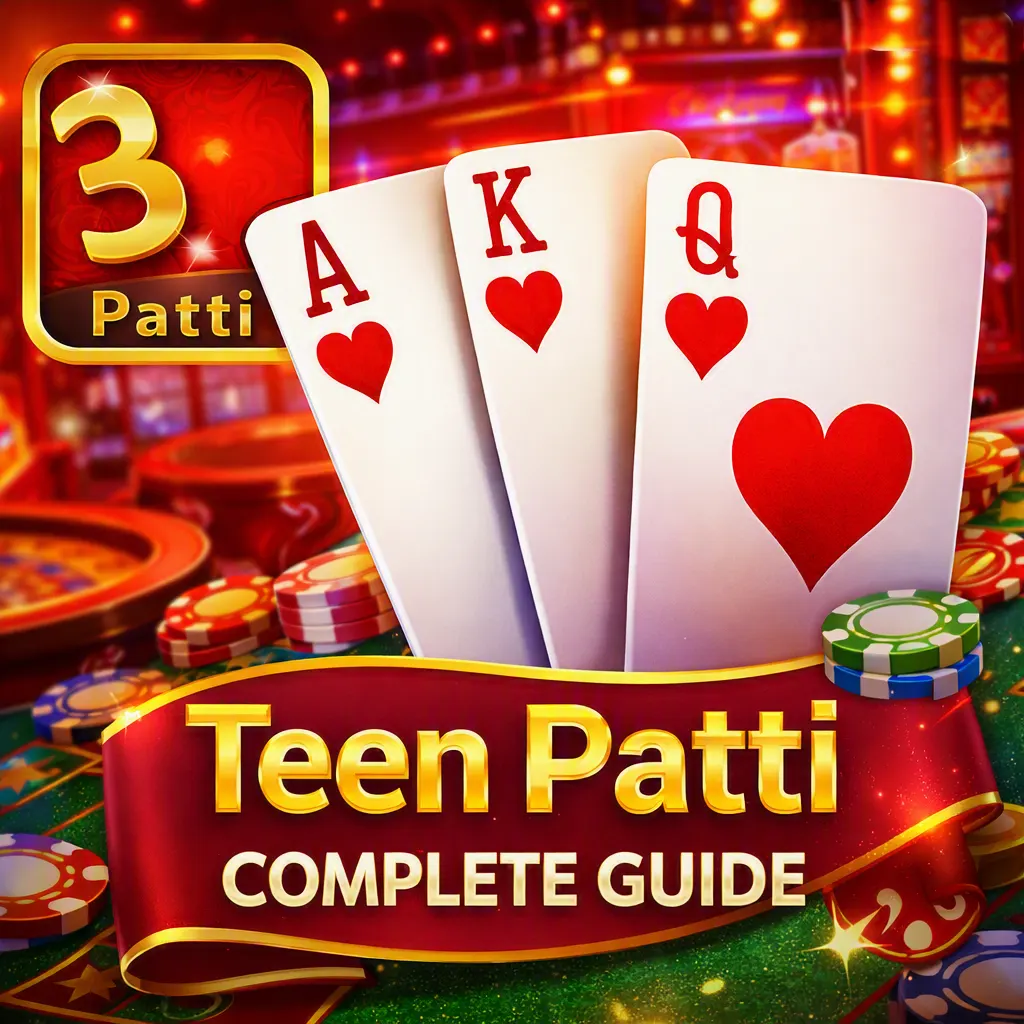
| Rank | Hand | What it is | Best example |
|---|---|---|---|
| 1 | Trail, also called trio or set | Three cards of the same rank | A-A-A |
| 2 | Pure sequence | Three consecutive cards, same suit | A-K-Q of hearts |
| 3 | Sequence | Three consecutive cards, mixed suits | A-K-Q |
| 4 | Colour | Three cards of one suit, not consecutive | A-K-J of spades |
| 5 | Pair | Two cards of the same rank | A-A-K |
| 6 | High card | None of the above | A-K-J, mixed suits |
Two things in that list catch people out. A sequence beats a colour here, which is the opposite of what poker players expect from three cards. And the strongest high card hand is A-K-J rather than A-K-Q, because A-K-Q would already be a sequence. The weakest hand you can be dealt is 5-3-2 in mixed suits.
Chapter 4: The odds most guides leave out
There are exactly 22,100 possible three card hands from a 52 card deck. Every hand you will ever be dealt is one of them, and they are not evenly distributed. Here is the full picture.
| Hand | Combinations | Chance | Roughly once every |
|---|---|---|---|
| Trail | 52 | 0.24% | 425 hands |
| Pure sequence | 48 | 0.22% | 460 hands |
| Sequence | 720 | 3.26% | 31 hands |
| Colour | 1,096 | 4.96% | 20 hands |
| Pair | 3,744 | 16.94% | 6 hands |
| High card | 16,440 | 74.39% | Most of the time |
Sit with that last row for a second. Three hands out of every four are nothing but a high card. Not a pair, not a sequence, nothing. The player betting into you almost certainly has a high card too, and the confidence in their bet is a decision they made, not a hand they were dealt.
It also reframes what a good hand looks like. A pair puts you in the top quarter of all hands, so a modest pair is worth playing, not apologising for. A trail arrives about once in 425 deals, which at a normal online pace is once every few sessions. If you are waiting for one before you commit chips, you will pay boots all evening and win nothing.
What the numbers do to your betting
Put the odds next to the betting rules and a few things follow immediately. A hand that beats a pair arrives about a quarter of the time, so when three players are still in after two rounds of confident betting, the chance that at least one of them holds a sequence or better stops being remote. That is the moment to stop paying to find out.
It also explains why the blind pricing matters so much. If most hands are a high card, most hands are decided by who was willing to keep paying. Paying half price for that argument is a structural advantage that has nothing to do with luck, and it is available to you on every single deal.
Chapter 5: The tie-breaks that start arguments
Ranking two hands of the same type is where table disputes come from. The rules are settled, they are just rarely written down.
- Trail against trail. Higher rank wins, so A-A-A is the best hand in the game and 2-2-2 is the weakest trail. It still beats every pure sequence.
- Sequences. A-K-Q is the highest. Then, and this surprises everyone, A-2-3 comes second. After that it runs normally from K-Q-J down to 4-3-2.
- Colour against colour. Compare the highest card. If those match, compare the second, then the third. Suit never breaks a tie.
- Pair against pair. The pair rank decides it first. When both players hold the same pair, the third card settles it, so A-A-K beats A-A-Q.
- Completely identical hands. This is the one to remember. Teen Patti does not split the pot the way poker does. The player who asked for the show loses. Calling a show is not free, and an even hand is a losing hand.
Chapter 6: The sideshow, and why beginners never use it
A sideshow, sometimes called a compromise, is a private comparison between two players in the middle of a hand. It is the sharpest tool in the game and most new players go months without touching it.
The rules are tight. Only a seen player can request one, only against the seen player who bet immediately before them, and only after paying their own bet for that round. You cannot ask a blind player for a sideshow. The other player can accept or refuse with no penalty for refusing.
If they accept, the two of you compare cards where nobody else can see them. The weaker hand folds on the spot. If the two hands are exactly equal, the player who asked is the one who folds.
What makes it valuable is not the comparison itself, it is the information. A refusal is loud. A player holding a trail almost never refuses, because they want you in the pot paying. A player refusing quickly is usually protecting a bluff they do not want examined. You have just learned something real about one opponent for the price of one bet, in a game where information is otherwise almost impossible to come by.
Chapter 7: How a hand actually ends
Three ways, and the cost is different in each.
- Everyone else folds. The last player standing takes the pot and never has to show the cards. You can win a hand holding 7-4-2, and that fact is the entire basis of bluffing.
- A show is called. Only possible when two players remain. A blind player can call a show for 1x the current stake. A seen player pays 2x. If your opponent is blind and you are seen, you cannot force a show at all. You either keep betting or fold.
- The table limit is reached. The pot hits its ceiling and the remaining hands are compared automatically. Nobody chooses the timing.
Chapter 8: The variations you will run into
Once you know the classic game, the lobby is full of versions that rewrite it. Strategy does not carry over cleanly, so read the rule panel before you sit down.
- Muflis. The rankings flip. The worst hand wins, so 5-3-2 becomes the best holding and a trail of aces is worthless.
- AK47. Aces, kings, fours and sevens all act as jokers. Strong hands appear far more often, so a colour that would win a classic hand loses here regularly.
- Joker, and the lowest or highest joker versions. One card is nominated wild, either fixed or drawn at the start of the hand.
- 999. You are chasing a hand closest to 999 rather than a ranked combination.
- Best of Four. Four cards each, and you build the strongest three from them. Everyone has better hands, so bets that would be brave in the classic game are ordinary here.
Chapter 9: Reading a table when you cannot see faces
Online you lose every physical tell, which sounds like it removes the psychology from the game. It does not. It moves the psychology into two things you can still observe: bet sizing and timing.
Bet sizing first. A player who bets the minimum for three rounds and then suddenly jumps to the maximum has usually just looked at their cards and liked them. That is not certainty, but it is a pattern that repeats often enough to price into your decision. The reverse is worth more. A player who has been maximum betting all evening and quietly drops to the minimum is often protecting a stack rather than a hand.
Timing second, with a warning. A long pause before a big bet is sometimes genuine deliberation and sometimes a deliberate act, and on a mobile connection it is sometimes just a lost signal. Treat timing as the weakest of the signals available, and never build a whole decision on it.
The most reliable read in the game remains the sideshow refusal from Chapter 6. It costs one bet and it is the only moment where an opponent has to make a decision about the strength of your hand instead of their own.
Chapter 10: Beginner strategy that survives contact with a real table
Stay blind while it is cheap
The early rounds are the cheapest rounds you will play, and blind halves that price. Look once the stake has climbed to a point where the decision actually matters. This is the single habit that separates a player who lasts an evening from one who does not.
Fold more than feels comfortable
Three quarters of hands are a high card. If you are seen, holding a weak high card, and someone is betting into you with conviction, folding is not cowardice, it is arithmetic. The boot you already paid is gone whatever you do next. Do not pay two more bets to protect it.
Size the session before you sit down
Decide the whole evening budget first, then pick a table where the boot is a small slice of it. A useful rule of thumb is keeping any single hand under 5% of what you brought. At a 10 rupee boot with 500 rupees, you can absorb a bad run and still be playing when the cards turn.
Watch the two or three players who matter
Most tables have one player raising every hand and one who only bets with something real. You do not need to profile everybody. Find the aggressive one and the cautious one, then price your bets against them specifically. A raise from the cautious player means something. The same raise from the aggressive one means nothing at all.
Respect the pair, but not too much
A pair is genuinely a top quarter hand and beginners fold it too often. They also overplay it. A low pair loses to every sequence, every colour, and every higher pair, which together turn up often enough to matter. Play it, but do not go to the table limit with 4-4-9.
Chapter 11: What Teen Patti is not
Online hands are dealt by a random number generator, and every deal is settled independently of the one before it. There is no cycle, no due card, and no pattern hiding in the last twenty hands. The streak you think you can see is the same illusion people find in coin flips.
That is also the honest answer about predictor apps, hack files and paid Telegram groups promising to call the next hand. Nothing can predict a deal that has not happened yet. What those tools do reliably is take a payment, or ask for your login and take the account. We wrote a longer version of this argument for crash games in our piece on whether the Aviator game is real or fake, and every word of it applies here.
One more thing worth knowing, because it affects you rather than the game. Indian courts have treated rummy as a game of skill since 1968, and that reasoning has never been extended to three card games. Teen Patti is generally classified as a game of chance, and real money play is regulated state by state rather than nationally. Check what applies where you live before you deposit anything. That is a legal question, not a strategy one, and it is worth five minutes of your time.
Chapter 12: Where to play, and how to keep it enjoyable
Teen Patti sits in the Bingo 101 app alongside the rest of the card floor, including rummy, Andar Bahar, Dragon vs Tiger, Seven Up Down, Jhandi Munda, Baccarat and Blackjack. The same account also opens the slots, the crash games and the instant games, so nothing needs a second download or a separate balance. If you are coming to the app for Teen Patti specifically, take the file from the official download page rather than a forwarded link, because modified builds of popular card apps are a real problem in India.
Then set the boundaries before the first hand rather than after a bad one. Decide what the session is worth, use the deposit and spending limits in the app, and stop at the number you picked while you were still thinking clearly. Chasing a loss is the one habit that turns a card game into a problem, and it never once worked because the next deal does not know you are owed anything. Our responsible gaming guide covers the tools in detail.
Real money play is for adults aged 18 and over. For wider context on regulated and compliant gaming in India, the All India Gaming Federation is the industry body worth reading.
Learn the rankings in an evening. The blind pricing, the sideshow and the fold discipline take longer, and they are what actually decide whether you finish the month up or down.